The right commercial gate depends on three things: how much room you have beside and in front of the opening, how much traffic goes through it, and whether the ground is flat. Swing gates are the simplest. Slide gates save space. Cantilever gates handle rough ground and heavy use without a track to clog. Add an automatic operator and access control, and the gate becomes the front door of your property.
This guide covers each gate type, what to look for in a gate operator, and how to pick the right access control. It’s part of our series on choosing commercial fencing.
Swing, Slide, or Cantilever?
Swing Gates
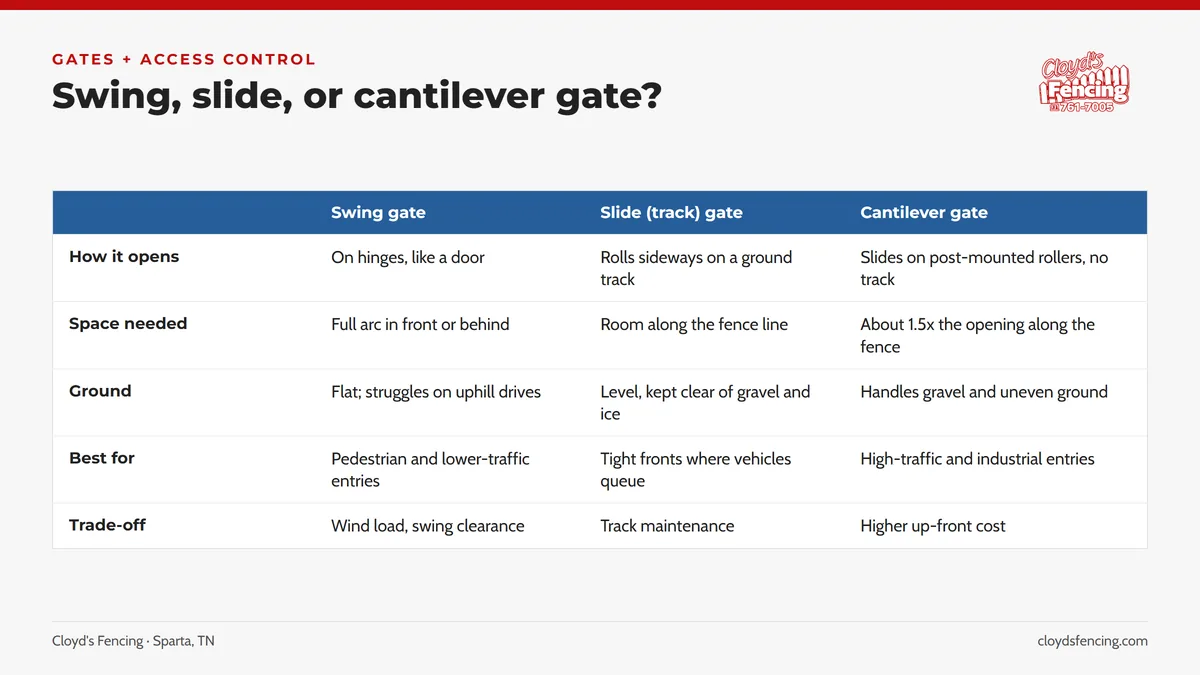
A swing gate opens on hinges like a door, either as a single leaf or a double gate that splits in the middle. It’s the simplest and usually the least expensive option.
The catch is space. A swing gate needs clear room to swing through its full arc, and it struggles on a driveway that slopes up past the opening, because the gate hits the ground. Swing gates work well for pedestrian gates, lower-traffic entrances, and wide, flat sites.
Slide Gates
A slide gate (also called a rolling gate) runs sideways on wheels along a track at the ground. It doesn’t need any swing room in front or behind, which makes it a good fit where vehicles line up close to the gate.
It does need room along the fence line, because the gate rolls back beside the opening. The track also has to stay clear of gravel, mud, leaves, and ice. On a gravel lot, plan for regular cleaning.
Cantilever Gates
A cantilever gate also slides sideways, but it rides on rollers mounted to posts beside the opening, so there’s no track on the ground. That makes it the strongest choice for gravel lots, uneven ground, and high-traffic industrial entrances.
The trade-off is that it needs extra room along the fence. The gate frame extends past the opening to counterbalance it, and that tail is usually at least half the width of the opening. Plan on roll-back space of about one and a half times the opening. Cantilever gates also cost more up front.
Manual or Automatic?
A manual gate is fine when it’s opened a few times a day by someone who has the key. If you have regular deliveries, tenants, employees on shifts, or customers coming and going, an automatic gate usually pays for itself in convenience and control.

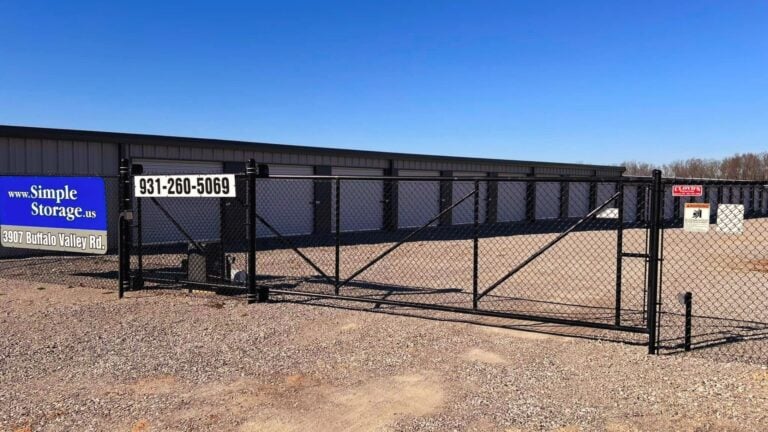
The self-storage facility above is a good example. Customers come and go all day, and the automatic slide gate keeps the lot closed without anyone having to stand there and work it.
What to Look for in a Commercial Gate Operator
The gate operator is the motor and control system that opens and closes the gate. For commercial work, ask about these:
- Safety listing. Automatic gate operators are covered by the UL 325 safety standard, which sets operator classes by use and requires entrapment protection, such as photo eyes and safety edges that stop or reverse the gate. DoorKing’s UL 325 overview explains the classes. Gate construction itself falls under ASTM F2200.
- The right class for your site. UL 325 separates residential, commercial and general access, industrial, and restricted-access operators. Match the operator to your traffic.
- Duty cycle. How many open-and-close cycles the operator is built for per hour and per day. A busy entrance needs a heavier-duty operator.
- Power and backup. Ask about battery backup, so the gate still works during a power outage.
- Service. Find out who maintains and repairs the operator after it’s installed.
Choosing Access Control
Access control is how people tell the gate to open. Most commercial sites combine two or three of these:
- Keypad: each user gets a code. It’s simple and inexpensive, and you can change the codes when people leave.
- Card or fob reader: faster than a keypad, and easier to manage for a large number of users.
- Remote transmitters: handy for employees and fleet vehicles.
- Phone or app entry: lets you open the gate from your phone and track who came in.
- Intercom or call box: visitors can call the office or a resident to be let in.
- Free exit: a vehicle sensor or exit loop opens the gate automatically for traffic leaving the property.
Important: Plan for emergency access. Your local fire department may require a way to open the gate during an emergency, such as a lock box or a siren-activated override. Ask before you finalize your access control.
Gates Are the Weak Point, So Build Them Right
A gate takes more abuse than any other part of a fence, so it’s worth building right the first time: heavy hinges or rollers, properly sized gate posts set in deep concrete, and an operator installed level and square. Gate posts carry far more load than line posts, especially on wide or automated gates.
For more on building a secure perimeter around your gate, read our guide to security fencing for commercial properties. If your gate will sit in a chain link fence, our commercial chain link fence guide covers the framework.
Gates and Controlled Entry From Cloyd’s Fencing
Cloyd’s Fencing installs commercial swing, slide, and cantilever gates, automatic gate operators, and controlled-entry systems for storage facilities, industrial properties, farms, apartment complexes, and businesses across Sparta, Cookeville, and the Upper Cumberland.
If you’re planning a new gate or adding automation to an existing one, request a commercial fence and gate estimate. Tell us the opening width, how much traffic it gets, and how you want people to get in, and we’ll recommend the right setup.