Farm & Agricultural Fencing in Sparta, Cookeville & the Upper Cumberland
Board fence, woven wire, high-tensile, and barbed wire fencing built to hold livestock and stand up to Tennessee pasture and terrain.
Strong, Dependable Fencing for Your Land and Livestock
A farm fence has a hard job. It has to hold animals that lean, push, and test it every day, run across hills and creek bottoms, and last through years of Tennessee weather. When it fails, you find out at the worst possible time.
Cloyd’s Fencing builds farm and agricultural fencing across Sparta, Cookeville, and the Upper Cumberland: pasture fence, cross-fencing, board fence along the road, and farm gates. We know this ground, the rock and the slope, and we build fence that holds.

Choose the Fence for the Animal
The first question isn’t the material. It’s what the fence has to hold. University of Tennessee Extension’s guide, Planning and Building Fences on the Farm, starts the same way: purpose first, then the species.
Board Fence
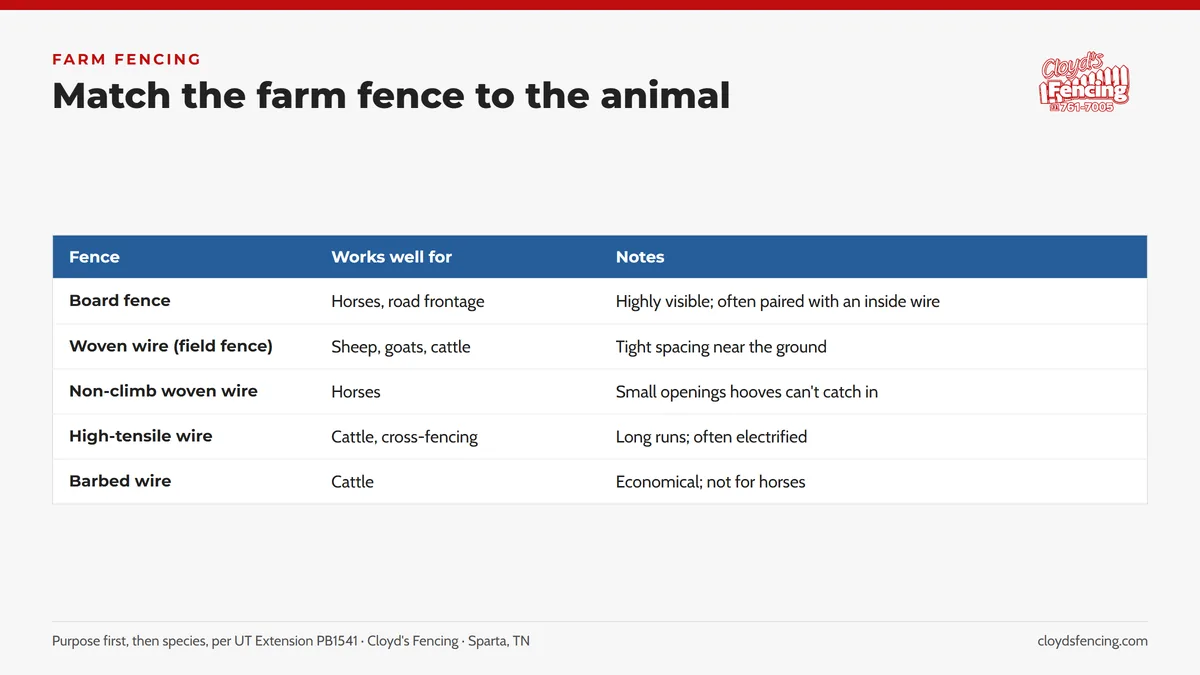
Wood board fence is the classic look for horse farms and roadside frontage. It’s highly visible, so horses see it and respect it, and it doesn’t have barbs to injure them. Three- and four-board styles are the most common. Many owners add a strand of wire or mesh on the inside to keep animals from chewing or leaning on the boards.
Woven Wire (Field Fence)
Woven wire fencing holds smaller livestock like sheep and goats, and it works for cattle too. Tight spacing near the ground keeps smaller animals from slipping through. Non-climb woven wire with small openings is a safer choice for horses.
High-Tensile Wire
High-tensile smooth wire fence is strong, long-lasting, and cost-effective over long runs of pasture. It’s often electrified for cattle and works well for cross-fencing and rotational grazing.
Barbed Wire
Barbed wire is a common, economical fence for cattle pasture. It isn’t a good choice for horses, which can be badly cut if they run into it or get tangled.
Built for Upper Cumberland Ground
- Corner and brace assemblies. A wire fence is only as strong as its corners. Braces carry the tension, so they’re built and set to hold it.
- Rock, slope, and creek crossings. Hillsides and rocky ground are normal here. We plan post spacing and line changes so the fence stays tight across uneven ground.
- Gates where you need them. Farm gates are placed for tractors, trailers, and moving animals, and hung on posts strong enough to carry them.

Cost-Share Help for Tennessee Livestock Farms
The Tennessee Agricultural Enhancement Program (TAEP) offers livestock fencing cost-share for eligible producers. The program sets its own requirements for fence types, height, and post spacing, and they can change each program year. Check the current TAEP guidelines and application window before you build, and we’ll build to the spec you need.
Frequently Asked Questions
What’s the best fence for horses?
Board fence and non-climb woven wire are the safest common choices for horses. Avoid barbed wire for horses. Many horse owners pair a board fence with an electric or mesh line on the inside.
What’s the best fence for cattle?
Woven wire, barbed wire, and high-tensile wire are all common for cattle. The right choice depends on your herd, your pasture layout, and whether you’re cross-fencing for rotational grazing.
Do you install farm gates?
Yes. We install pasture and drive gates for farms, and we can automate a farm gate with a solar or hardwired automatic gate operator.
Do you repair or replace old farm fence?
Yes. We replace sagging wire, broken boards, and failing corner braces, and we replace whole runs when a repair won’t hold.
Let’s Talk About Your Farm Fence
Tell us about your land, your livestock, and how much fence you need, and we’ll walk it with you and give you a clear, straightforward estimate. Call us at 931-761-7005 or send us a message. For agricultural businesses and larger commercial projects, request a commercial quote. Looking for wood fencing around the farmhouse? See our wood fencing page.